

Biblical Literacy for Catechists: Adam and Eve
This is the first article in a series about figures in Salvation history and their relevance for catechists.
Every catechist should be able to tell the timeline of Salvation history, because it is so important to understanding Jesus, the Bible, and Catholic doctrine. Salvation history is the story of our faith. Familiarity with important characters from this story helps us form a foundation of our belief in Christ. Jesus associated himself with major figures from the Old Testament such as Moses, Elijah, and others. So did his first followers. The Church continues to do so today.
Most characters in this story are named in the genealogy of Jesus (Matthew 1:1–17), which we hear on Christmas Eve. Matthew begins with Abraham and ends with Mary and Joseph. Yet this genealogy does not include Adam and Eve, who are crucially important to the story of our salvation.
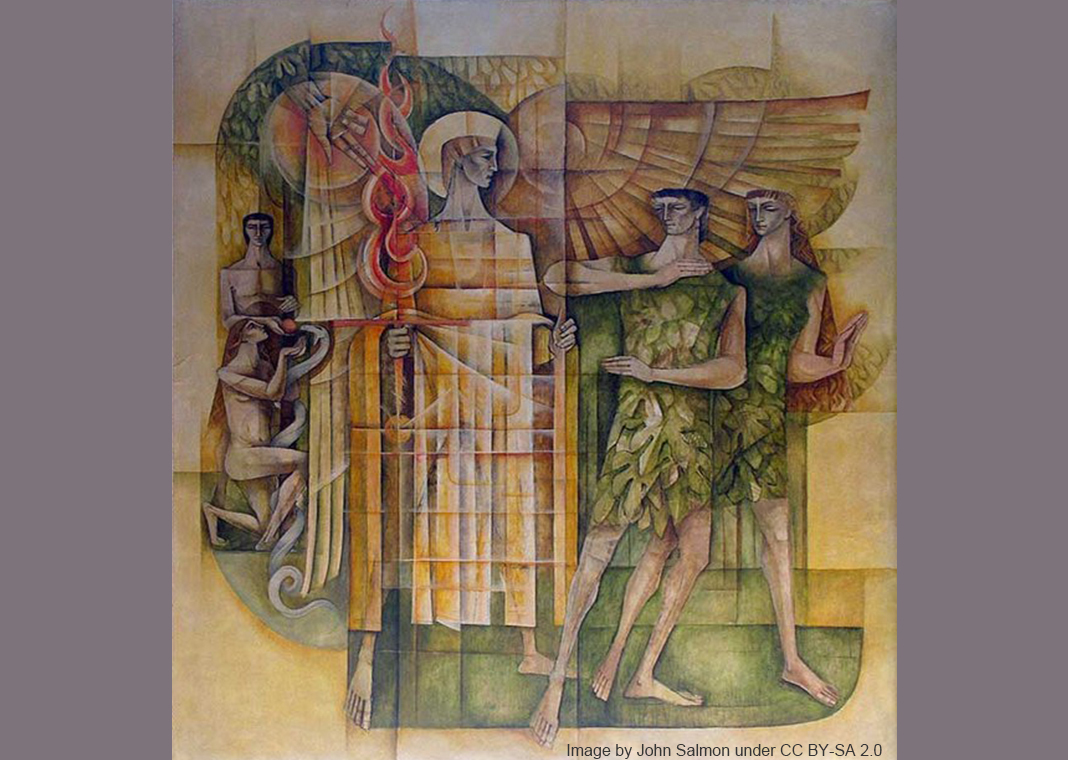
In the Exsultet at the Easter Vigil we hear, “O truly necessary sin of Adam, destroyed completely by the death of Christ.” When Adam and Eve ate from the of tree of knowledge of good and evil (Genesis 3:1–7), they became the conduit for the grace of redemption through a second “tree”: the Cross of Christ.
As Adam and Eve are expelled from Eden, God tells the serpent, “I will put enmity between you and the woman, / and between your offspring and hers; / he will strike your head, / and you will strike his heel.” (Genesis 3:15) In the second century, St. Irenaeus of Lyon made the connection between this promise and the coming of Christ.
St. Paul recognized Jesus Christ as the second Adam: “Thus it is written, ‘The first man, Adam, became a living being’; the last Adam became a life-giving spirit. But it is not the spiritual that is first, but the physical, and then the spiritual. The first man was from the earth, a man of dust; the second man is from heaven.” (1 Corinthians 15:45–47) From the first man—Adam—came sin. From the second man—Jesus—came redemption. This correspondence between Old Testament figures and Christ is called typology, and is an established way of interpreting Scripture.
The early Church Fathers also associated Mary, the mother of Jesus, with Eve. St. Justin Martyr (100–165 A.D.) wrote that just as Satan caused the virgin Eve to give birth to disobedience and death, the Virgin Mary, through the Spirit, gave birth to our Redeemer. Mary is therefore called the Second Eve, a title that has become part of the Tradition of the Church.
Adam and Eve are important to Jesus’ story. As we continue to learn how the people in the Old Testament help us understand Jesus Christ, we can share our understanding with our students.
What are some ways you can help your students understand the story of Adam and Eve?
Image: Church of St. Michael and All Angels, Lansdowne Drive, London Fields, London E8: mural of the archangel expelling Adam and Eve from the Garden of Eden, by John Salmon under CC BY-SA 2.0.

Joyce Donahue
Joyce Donahue, MA, MPS, is a liturgical catechist and former diocesan administrator.
See More